The Ghost of Duke: Recovering My 20-Year-Old Sun Java Certification
There is a special category of digital archaeology that only hits you when you log into an enterprise portal you haven't touched in twenty years.
Earlier today, while untangling an ancient account thread through Oracle’s labyrinthine CertView (the credential manager that swallowed Sun Microsystems’ training registry after the 2010 acquisition), I stumbled across something that stopped me dead in my tracks.
Sitting there, frozen in digital amber, was an official Sun Microsystems badge:
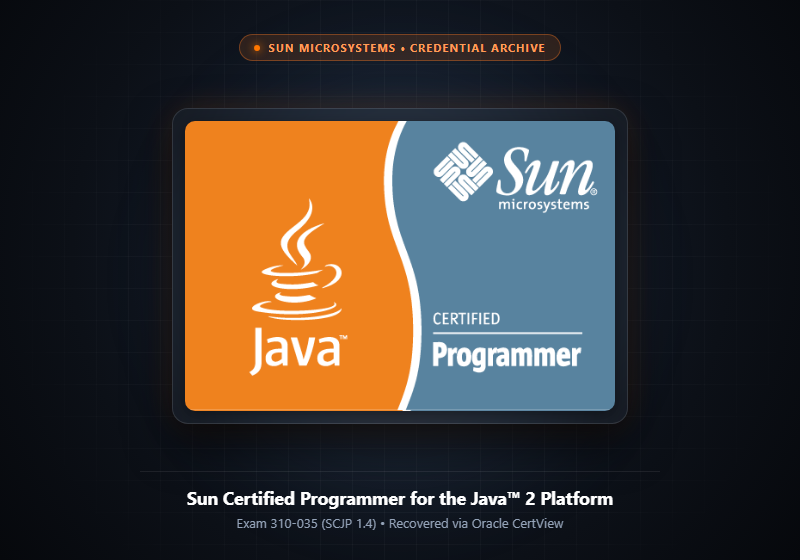
Sun Certified Programmer for the Java 2 Platform (SCJP 1.4). Exam 310-035.
I couldn’t help but laugh out loud. Twenty years later, through company acquisitions, platform overhauls, database migrations, and the slow extinction of Sun itself, that little two-tone orange and slate-blue badge survived.
For anyone who started their software engineering career after 2015, certifications might seem like sterile corporate checkbox exercises. But back in the mid-2000s, the Sun Certified Java Programmer exam wasn’t just a certification.
It was a trial by fire.
The Crucible of Exam 310-035
Taking a certification exam in the mid-2000s had a distinct physical aesthetic. You drove out to a suburban corporate office park, walked into a windowless Prometric or Pearson VUE testing center, and surrendered your phone, wallet, and car keys to a proctor who looked at you like you were entering maximum security.
They handed you a laminated sheet of plastic, an erasable marker with half its felt tip frayed away, and led you to a desk with a humming beige CRT monitor.
And then the exam started.
SCJP 1.4 was legendary among developers because it had almost nothing to do with whether you could build useful business software. It was designed to test whether your biological brain could execute the Java Language Specification with higher fidelity than the bytecode verifier itself.
The exam didn’t ask high-level architectural questions. It asked questions like:
// Question: What is the output of this code snippet?
byte b = 127;
b++;
System.out.println(b);
If you said 128, you failed. If you said compiler error, you failed. The correct answer was -128, because in Java, byte is signed 8-bit two’s complement arithmetic, and when you increment 01111111, you overflow to 10000000.
They tested you on operator precedence subtleties that would get you fired if you wrote them in production:
int x = 5;
x += (x = 3);
System.out.println(x); // Prints 8, because left operand is evaluated before right
They tested bitwise unsigned right shifts (>>>) versus sign-extending shifts (>>). They tested the exact rules of IEEE-754 floating point arithmetic (Float.NaN == Float.NaN is strictly false). They tested String pool internals (new String("foo") != "foo" unless you called .intern()).
And worst of all, they loved the infamous "Garbage Collection Eligibility" question. You would be presented with 40 lines of convoluted spaghetti code featuring nested anonymous inner classes, shadowed variable references, and cyclic dependencies. The question was always the same: "At line 32, exactly how many objects are eligible for garbage collection?"
You would sit there in that cold room with your squeaky dry-erase marker, drawing pointer graphs on a whiteboard tile, sweating bullets over whether an unreferenced StringBuffer was still reachable through an unclosed inner scope.
Enterprise Java in 2004: The Wild West
Looking at that vintage badge also triggered a flood of memories about what writing Java actually felt like back then. We take modern tooling so profoundly for granted today that it’s almost terrifying to look back.
1. Life Before Generics
In Java 1.4, Java didn't have generics yet. (Generics arrived in Java 5.0 in late 2004, but enterprise migration took years). Every collection was a raw, untyped bucket of Object references. Writing Java meant casting everything by hand and praying to the runtime gods:
// Java 1.4: Living on a prayer
List items = new ArrayList();
items.add("Hello, Sun");
items.add(new Integer(42)); // Perfectly legal at compile time!

// At runtime...
for (int i = 0; i < items.size(); i++) {
    String str = (String) items.get(i); // CRASH: ClassCastException
}
2. Raw Thread Concurrency
There was no java.util.concurrent. Doug Lea’s legendary concurrency utilities weren't part of the standard library yet. There were no thread pools out of the box, no CompletableFuture, no AtomicInteger, and no ReentrantLock.
If you wanted multi-threaded execution, you created a raw new Thread(runnable), managed object monitor locks with synchronized(lock), and called low-level primitives like lock.wait() and lock.notifyAll(). If you made a single mistake in lock ordering or forgot to wrap your wait() in a while loop to guard against spurious wakeups, your production server silently deadlocked and froze into a solid block of ice.
3. The J2EE 1.4 XML Hell
If core Java was demanding, enterprise Java was downright punitive. In J2EE 1.4, Enterprise JavaBeans (EJB 2.0/2.1) ruled the corporate world. To perform the equivalent of what today is a 4-line Spring Data repository or JPA query, you had to write:
- A Home Interface (defining bean lifecycle methods)
- A Remote / Local Interface (defining business methods)
- A Bean Implementation Class (implementing container-managed persistence)
- An
ejb-jar.xmldeployment descriptor - A vendor-specific deployment descriptor (e.g.,
weblogic-ejb-jar.xmlorjboss.xml)
You spent more time wrestling with 500-line XML schemas than writing actual business logic. You built the project using monolithic Apache Ant build.xml files that took 10 minutes to run, packaged everything into a 150-megabyte .ear file, and deployed it to a beastly server like BEA WebLogic 8, IBM WebSphere, or JBoss 3.
Twenty Years Later: The Quantum Leap
Finding that badge forced me to reflect on just how radically the Java ecosystem has transformed over the past two decades.
People outside the JVM ecosystem often still hold the cliché that Java is an antiquated, verbose language trapped in the early 2000s. But if you compare Java 1.4 to modern Java (Java 21 LTS / Java 25), they look like two completely different programming languages that happen to share a bytecode format:
Today, with Virtual Threads (Project Loom), you can write straightforward, imperative, blocking code that effortlessly handles millions of concurrent requests without thread starvation or reactive callback hell. With Pattern Matching and Sealed Classes, writing domain logic in Java feels clean, concise, and expressive. With GraalVM, Java compiles down to instantaneous native machine code.
The contrast between debugging manual object monitors on a 32-bit JVM in 2004 versus spinning up containerized microservices on modern 64-bit multi-core architectures today is staggering.
Why the Old Crucible Still Matters
As silly as it feels to look at an ancient certification badge from a company that hasn't existed as an independent entity in sixteen years, I realized something important while staring at it.
That hyper-pedantic, punishing exam was actually one of the single best foundations I could have ever asked for as a software engineer.
In today's development ecosystem, high-level frameworks and AI assistance make it remarkably easy to build software without ever understanding what the underlying runtime is actually doing. You can ship features for years without knowing how memory is allocated on the heap, how reference chains prevent garbage collection, or how thread scheduling interacts with CPU cache lines.
The SCJP exam forced you to care about the silicon. It forced you to look past the syntax and visualize the stack frames, the operand stack, the constant pool, the memory barriers, and the lifecycle of an object in memory.
Frameworks come and go. J2EE gave way to Spring, which gave way to Spring Boot, which now coexists with Quarkus and Micronaut. Build tools evolved from Make and Ant to Maven to Gradle. Sun Microsystems became Oracle.
But the core computer science principles never went out of date.
Understanding how data structures behave under concurrency, how references are garbage collected, and how the virtual machine interprets instructions is just as valuable on a 16-core Intel Core Ultra running Linux containers today as it was on a single-core Pentium 4 running Solaris in 2004.
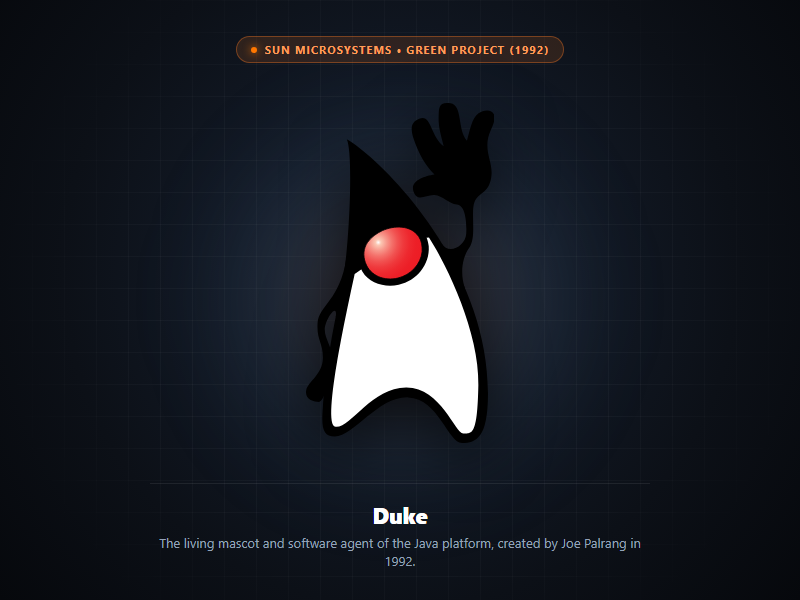
And of course, no retrospective on 2000s Sun Java would be complete without paying homage to Duke—the heavy-nosed, cheerful mascot created by Joe Palrang in 1992 for Sun’s Star7 PDA prototype before Java even had its name. Duke was everywhere back then: animated in demo applets, printed on oversized mousepads at Sun conferences, and waving back at you from the official documentation.
So here's to Duke, to Sun Microsystems, to "The Network Is The Computer," and to the digital ghost in Oracle's database that refused to let my 20-year-old certification die.
